Affiliate Disclosure: This post may contain affiliate links, which means the American Crochet Association may earn a small commission from qualifying purchases made through links on our site, at no additional cost to you. Learn more on our Disclosures and Disclaimers page.
If you’ve ever seen a crochet designer looking for pattern testers and wondered how to be a crochet pattern tester, these beginner-friendly tips will help you to get started.
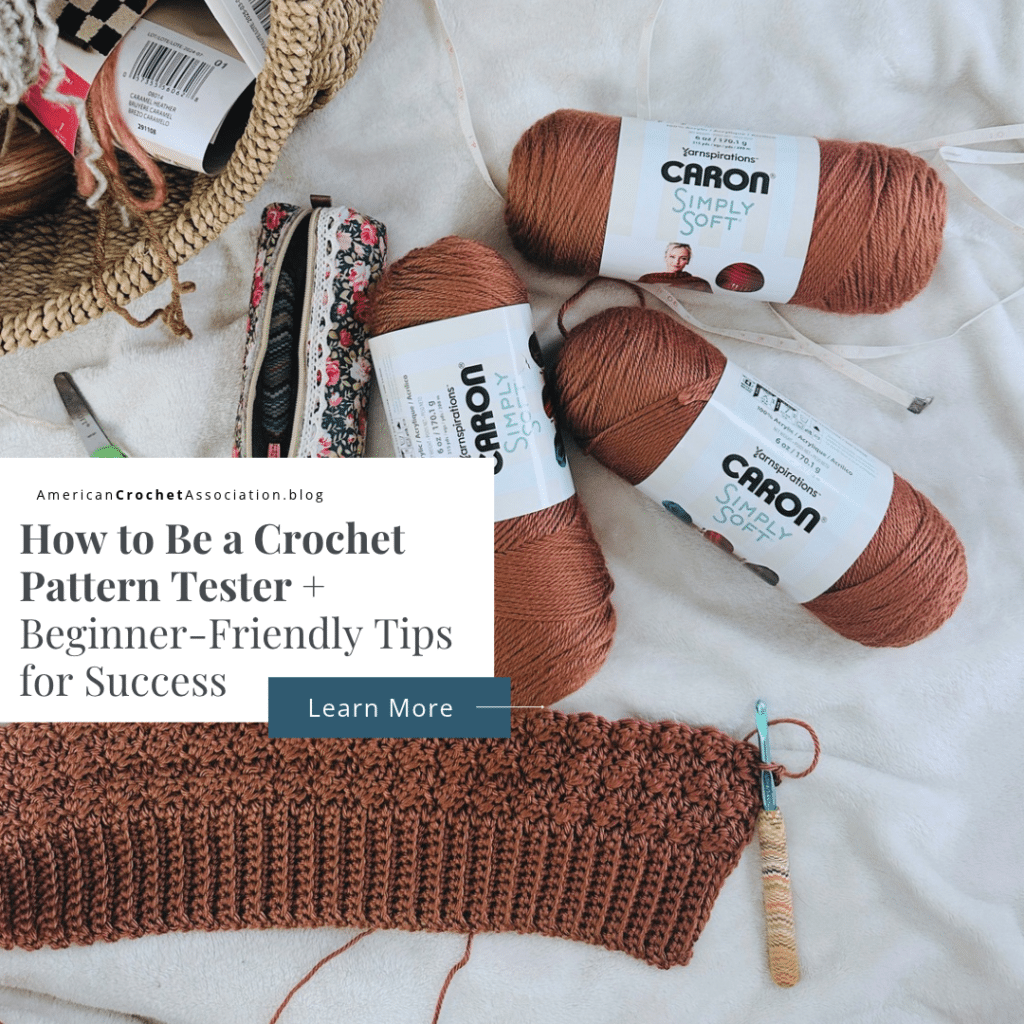
Crochet pattern testing is a great way to improve your crochet skills, try new designs, discover independent designers, and help make crochet patterns easier for others to follow.
Being a pattern tester can simply involve crocheting a project, but you’re also helping a writer make sure their pattern is clear, accurate, and works as intended before it’s shared with the world.
The good news? You don’t have to be an expert crocheter to be a good pattern tester.
You just need the skills required (and materials) for the project, an ability to follow instructions, and the willingness to share helpful feedback.
Let’s look at what crochet pattern testing is, what to expect, and how to become a helpful and reliable pattern tester.
Estimated reading time: 11 minutes
Table of contents
- Hi, I’m Salena Baca!
- What Is Crochet Pattern Testing?
- What Does a Crochet Pattern Tester Do?
- Crochet Pattern Testing Tips
- Choose a Pattern Test That Fits Your Skills and Schedule
- Read the Entire Pattern Before You Start Crocheting
- Follow the Pattern Exactly as Written
- Keep Track of Your Stitches, Rows, and Rounds
- Pay Attention to Anything That Makes You Stop
- Ask Questions and Give Specific Feedback
- Leave Feedback in the Right Place
- Communicate if Something Changes
- Finish the Project and Submit Photos
- Share Honest Feedback About Your Experience
- Do Crochet Pattern Testers Get Paid?
- Join a Pattern Testing Group
- Download | Pattern Testing Checklist
Hi, I’m Salena Baca!
I’m the founder of the American Crochet Association (ACA), a crochet designer, author, and educator. I’ve been crocheting since I was about five years old and began working professionally in the crochet industry in 2009.
Over the years, I’ve published more than 550 crochet patterns, authored 18 crochet books (including Learn To Crochet), and developed every course and lesson at the ACA.
I’ve also worked in crochet publishing, taught classes and workshops, and created educational programs to help crocheters build their skills and explore crochet-related careers, including the ACA’s Pattern Writing Training course.
Through the ACA, I help crocheters build their knowledge and skill so they can ensure crochet is passed through the generations in better hands than we found it.
That’s why I believe crochet patterns should follow consistent formatting standards, be accurate, and be written for a universal audience. And pattern testing is an important part of that process!
Whether you’re testing your first pattern or looking to become a more knowledgeable and reliable tester, I’m here to help you understand what to expect and get started with confidence.
What Is Crochet Pattern Testing?
Crochet pattern testing is the process of making a crochet project by following a designer’s written instructions before a pattern is published.
Designers ask testers to work through their patterns to identify errors, confusing instructions, missing information, and other issues that could make a project difficult to complete.
A pattern might look perfect to the person who designed it – but without testing – crocheters may interpret instructions differently, find that a stitch count doesn’t add up, or catch a typo that completely changes the design (like sc instead of dc – big difference).
Pattern testers help designers see their work from a crocheter’s perspective.
Their feedback gives designers an opportunity to correct mistakes, clarify instructions, and improve the overall pattern before publication.
What Does a Crochet Pattern Tester Do?
As a pattern tester, you’re asked to follow a pattern as written, complete the project, and share feedback with the designer.
Depending on the pattern and the testing requirements, you may be asked to:
- Read through the pattern before you pick up your hook.
- Check for spelling errors, typos, and inconsistent abbreviations.
- Follow the written instructions without making changes.
- Check stitch counts as you work.
- Identify instructions that are confusing, incomplete, or difficult to follow.
- Ask questions when something doesn’t make sense.
- Make suggestions if you think something could work (or sound) better.
- Finish the project by the agreed-upon deadline.
- Submit photos of your finished project and any other requested information.
Your role is simply to see if a pattern is clear, accurate, and complete, to create a project with the least amount of difficulty.
Crochet Pattern Testing Tips
Ready to try pattern testing?
Every designer (and call for pattern testing) will outline their own process, requirements, and expectations.
You should always follow the requirements of a specific testing call, since each designer may have a different process.
The tips in this article will help you get started and make the most of the pattern testing experience.
Choose a Pattern Test That Fits Your Skills and Schedule
Before signing up, read the entire pattern testing call carefully.
Look for information about the project’s difficulty, required materials, expected skills, testing deadline, and any special requirements.
Ask yourself:
- Do I know how to make the stitches and techniques required?
- Do I have the correct yarn, hook, and other materials?
- Will I finish the project by the deadline?
- Am I comfortable using the tools required for testing, such as Google Docs?
- Am I willing to provide feedback and follow the testing instructions?
Be honest with yourself. It’s better to choose a test you can complete comfortably than to commit to a project you don’t have the time or skills to finish.
And remember, not every pattern test is right for every crocheter (and that’s okay)!
Read the Entire Pattern Before You Start Crocheting
Before picking up your hook, read through the pattern from beginning to end.
This gives you an opportunity to understand the project, become familiar with the instructions, and spot issues before you begin.
Pay attention to:
- Spelling errors and typos.
- Incorrect or inconsistent crochet abbreviations.
- Missing stitch counts or counts that don’t seem to add up.
- Confusing repeat instructions or repeat symbols.
- Missing information about materials, sizing, or construction.
- Parts of the pattern that make you stop and think, “What does this mean?”
You don’t need to solve every issue during this first read-through.
Simply make note of anything that seems incorrect or unclear so you can ask questions or revisit it during testing.
These resources can help you understand common crochet standards and formats:
Crochet Abbreviations Overview and Cheat Sheets
What Counts as a Crochet Stitch?
Crochet Repeat Symbols Cheat Sheet
No matter how long you’ve been crocheting or how many projects you’ve completed, these resources can help you find answers to common questions and troubleshoot problems.
Follow the Pattern Exactly as Written
This is one of the most important parts of pattern testing!
Your goal is to find out whether you can successfully make the project by following the written instructions, without filling in gaps or correcting mistakes based on your own experience.
Work the pattern exactly as written.
If something is missing, confusing, incorrect, or could be improved, pause and document the issue.
Ask the designer for clarification when needed, and share suggestions for improvement.
Unless the designer gives you permission, don’t change the stitch pattern, adjust the construction, substitute techniques, or modify the design.
If you quietly fix a problem and keep going, the designer may never realize the instructions need attention.
A good pattern test evaluates the written instructions, not your ability to work around them.
Keep Track of Your Stitches, Rows, and Rounds
Stitch counts are an important part of pattern testing.
A small counting error can change the shape, size, or appearance of an entire project.
As you work, check your stitch counts at the end of each row or round when counts are provided.
Pay attention to increases, decreases, repeats, and any changes in the instructions.
If your count doesn’t match the pattern, stop and investigate:
- Did I follow the instructions correctly?
- Did I miss a stitch or accidentally add one?
- Is the stated stitch count correct?
- Could the instruction be interpreted in more than one way?
Even if you discover that the mistake was your own, the experience may reveal an instruction that could be clearer for other crocheters.
Pay Attention to Anything That Makes You Stop
Every time you stop, backtrack, reread an instruction, or find yourself guessing what to do next, take note.
These moments can reveal opportunities to improve a pattern.
Perhaps an instruction is technically correct but difficult to understand.
Maybe a repeat is easy to lose track of, or a technique needs a little more explanation.
Check out our Crochet Memberships for all skill levels!
From First Stitch to Crochet Career, Unravel Your Complete Journey With The American Crochet Association!
Don’t assume that something is obvious just because you eventually figure it out.
A pattern should give crocheters the information they need to complete a project without a lot of guesswork.
Ask Questions and Give Specific Feedback
You don’t have to figure everything out on your own.
Asking questions is part of the testing process!
When you find a problem, explain exactly what happened.
Include the row or round number, the relevant instruction, your stitch count, and what confused you.
For example, instead of writing:
“I’ve been crocheting for 50 years, and I can’t make this work.”
Try something more specific:
“Round 6 says to repeat the instructions four times, but I end the round with 30 stitches instead of the stated 32.”
Specific feedback helps the designer locate the issue and understand what needs attention.
Leave Feedback in the Right Place
Follow the designer’s instructions for submitting feedback.
For example, ACA pattern writers use comments directly in a shared Google Doc to review questions and suggestions while viewing the same document.
If you’re new to Google Docs, this tutorial will help you get started:
How to Pattern Test With Google Docs
Keep your feedback organized, and avoid sending the same comments through multiple channels unless the designer requests it.
If you have a question about the testing process itself, contact the designer using the method provided in the pattern testing call.
Communicate if Something Changes
When you agree to test a pattern, the designer is counting on you to complete the work within the agreed-upon timeframe.
Before committing, make sure the deadline is realistic for your schedule.
Remember to account for the time needed to gather yarn, complete the project, review your notes, take photos, and submit feedback.
Life happens, and sometimes plans change. That’s okay!
If you realize you can’t finish on time, communicate with the designer as soon as possible rather than waiting until the deadline has passed.
Reliable communication is just as valuable as crochet skills when it comes to being a good pattern tester.
Finish the Project and Submit Photos
If the designer requests finished-project photos, take clear pictures in natural light or a well-lit area.
Make sure the details of your work are easy to see, especially any stitch patterns, shaping, or finishing techniques.
Some tests may also ask you to add your project to Ravelry and link it to the pattern.
This tutorial will help: How to Add a Project to Ravelry
Share Honest Feedback About Your Experience
Pattern testing is about more than finding errors.
Your experience making the project can help the designer understand what worked well, what could be easier, and whether there are other ways to achieve the same result.
As you work, think about the overall process:
- Could another technique be easier, faster or more polished? A chainless foundation might create a neater edge with less puckering over a traditional chain.
- Would another method give a better result? Perhaps a chain is more secure than an adjustable loop.
- Were the instructions easy to follow? Could a section be explained more clearly or written with fewer words?
- Was the pattern easy to read? Consider the font size, spacing, layout, and how easily you could follow along while crocheting.
- Did you enjoy making the project? Was the process enjoyable, frustrating, or more complicated than you expected?
Share your observations honestly and respectfully.
Testing is an opportunity to share your experience and offer suggestions the designer may not have considered.
If you have concerns that could affect your overall review (like adding your project to Ravelry), contact the designer before making that feedback public.
This gives the designer a chance to hear your feedback and make changes while the pattern is still being tested.
Your feedback helps designers understand not just whether a pattern works, but how the experience of making it could be improved.
Do Crochet Pattern Testers Get Paid?
Compensation varies from one pattern test to another.
Designers may offer payment, yarn, products, or other benefits.
Testers who complete a project and submit all required feedback by the deadline will typically receive a complimentary copy of the final published pattern, usually delivered through Ravelry.
Always check the individual testing call for the specific compensation and requirements.
Before committing, make sure the time, materials, and compensation work for you.
Join a Pattern Testing Group
The ACA Crochet Pattern Testing Group brings crocheters together with ACA Crochet Pattern Writers to improve crochet patterns through real-world testing.
Our goal is to create a supportive, respectful community where designers receive helpful feedback and testers have opportunities to discover new designs and contribute to better patterns.
Who can join?
Any crocheter is welcome to join as a pattern tester.
However, only approved ACA students enrolled in the Crochet Pattern Writing Training + Design Course may post pattern testing calls through the program’s application process.
If you’d like to write and publish your own crochet patterns, our training program walks you through the process of designing, writing, testing, publishing, and selling your work.
You’ll find step-by-step guidance, pattern templates, video tutorials, and practical resources to help turn your ideas into polished, publish-ready patterns.
Whether you’re interested in testing someone else’s design or learning how to bring your own patterns to life, there’s plenty to learn along the way.
Download | Pattern Testing Checklist
Use this two-page checklist as a quick guide while testing to help you through the general process.
Use this large-font checklist as a quick guide while testing to help you through the general process.
A Final Word for Crochet Pattern Testers
Being a pattern tester isn’t about being perfect, knowing every crochet technique, or catching every single mistake.
It’s about showing up, following instructions, paying attention to details, and sharing your experience honestly.
You bring your time, yarn, skills, questions, and perspective to the process.
In return, you help a writer improve their work and make their patterns easier for others to enjoy.
So, if you see a pattern testing call that interests you and fits your skills and schedule, I hope this outline gives you the confidence to give the process a try. Happy testing!
Peace + Love + Crochet
Salena Baca